Posted by matthew on Sep 18, 2009 in
education,
technology 
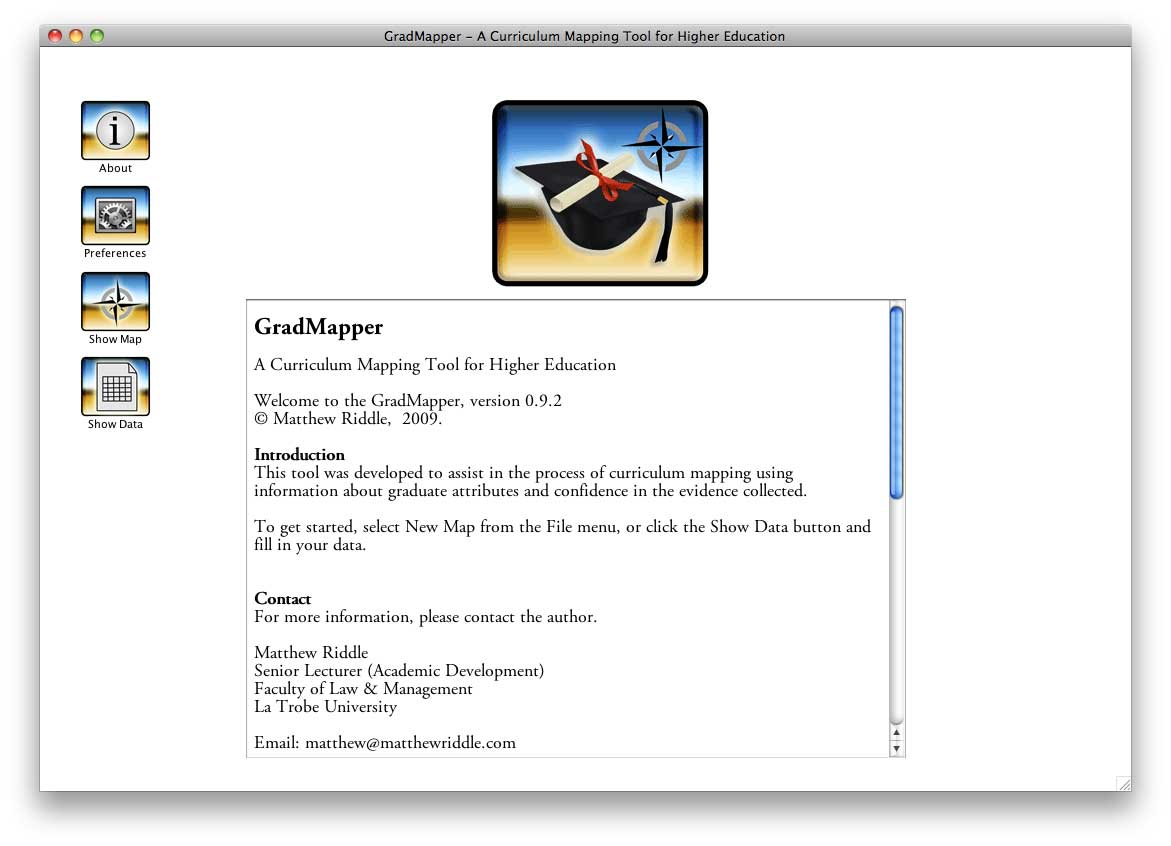
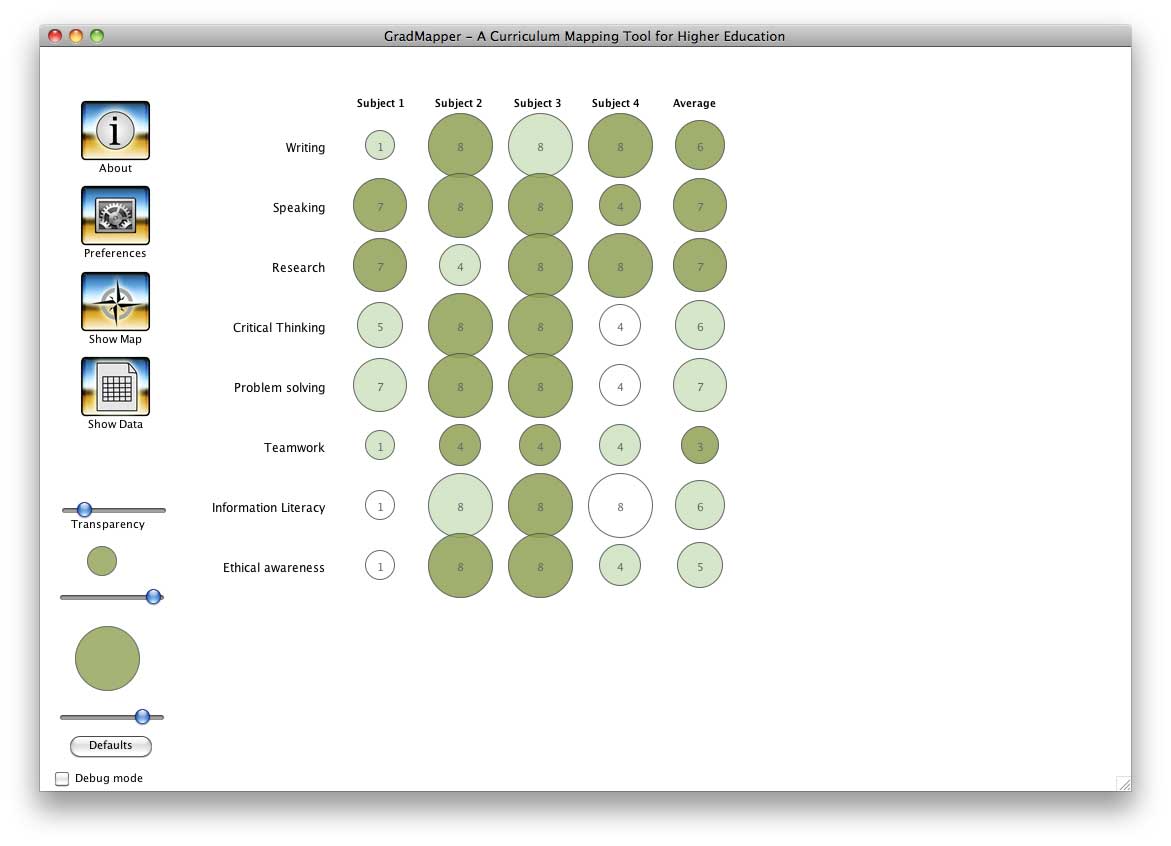
Since downloading revMedia a couple of weeks ago (see previous post), my little project has turned into something that I hope will be quite useful. I’ve written an application (in the end using Revolution Studio) that creates heat maps! It’s called GradMapper, and this is what it looks like:
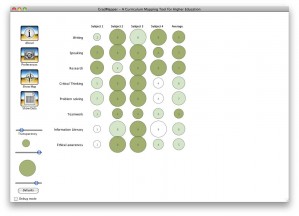
The project I’m working on is about curriculum mapping. The problem is to get a picture of where students are exposed to various generic skills (or ‘graduate capabilities’) like writing, speaking, critical thinking, team work, and so on across a program of study. A heat map allows information in a couple of different categories to be combined in one two dimensional map, through the use of colour/shade as well as size. The columns are subjects, the size of the bubbles represents how much something is taught, and the intensity of the colour represents how confident we are with the evidence. I took a look at what kind of software was out there to create this kind of a diagram, and realised it was reasonably easy to create something with off the shelf packages like Excel, but it was difficult to really customise the look of the graphs or create a workflow to suit the task.
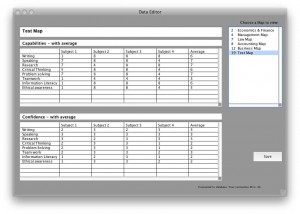
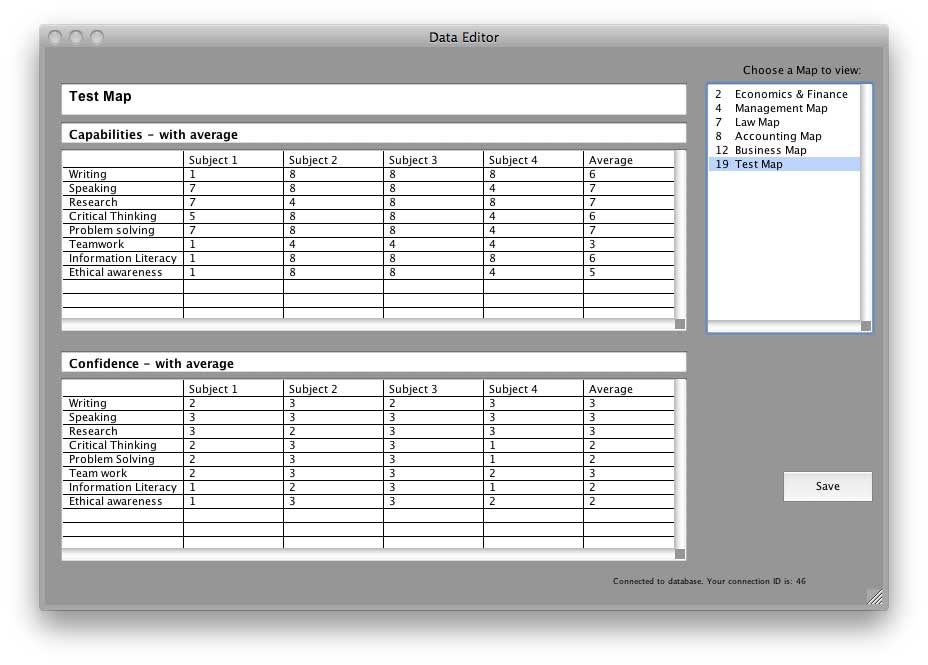
I realised that I really wanted to be able to create a simple table of data, look at the map, and save it online, without dealing with uploading/downloading every time. I wanted to be able to click a menu and compare two graphs from two different programs, overlay them if necessary, and share the data with someone somewhere else. After mucking around with Revolution for a while I realised it was going to be easier to write my own application, and that other people might want to use it as well. What’s more, it would be much easier to share the methodology we developed for our project if there was a tool like this to support it. The Data Entry screen above is where the tables are entered. Clicking on the list of Maps on the right selects a map. The application uses MySQL to store the map data, and draws the maps as you go. It’s working really well now, and I’m adding new features daily. The next version will have the ability to overlay multiple maps for comparisons. And yes, it will be available for Mac and Windows — I will probably also post an online test version here using the revWeb plugin when it becomes a bit more stable. If you’re interested in being a beta tester, please let me know.
Posted by matthew on Aug 28, 2009 in
education,
technology Not everyone will remember HyperCard, but those out there who do certainly remember it fondly. In many ways, HyperCard is the reason I first became interested in educational technology, and it is certainly the reason that I was able to get into programming. People who know me now as a bit of a technophile are always surprised when I tell them that my first experience with computers at school left me cold. I took very little notice and couldn’t see any point at all in writing a 20 line basic program that could write my name.
When my mum brought home a MacPlus in 1987 I remember becoming captivated by the paper white screen, the Finder icons and MacPaint, but when HyperCard came along later that year I was quickly obsessed by the idea that I could create my own applications. I am pretty sure I was more interested in messing around with HyperCard than my final year of school, but my gap year turned out to be an opportunity to start working on it more seriously. To cut a long story short, basically my entire career can be traced back to the opportunities provided by HyperCard to quickly and easily test out new ideas and then make something useful from them.
So when HyperCard was left to wither in the 90s and finally dropped by Apple in 2004 I was naturally very disappointed. HyperCard is not supported by MacOSX. I’ve used most of the commercial products that have tried to keep the dream alive, including in particular SuperCard and Revolution, but there has always been a reason not to invest the time and effort required to use them.
However, the time may well have arrived for the return of HyperCard in the form of a new web-only development tool by the people who make Revolution. It’s called revMedia, and the best part is that it’s absolutely free. As their press release says:
“revMedia is a fully featured authoring tool that includes an integrated development environment (IDE) for Windows, Mac OS X and Linux.”
I downloaded the alpha without high expectations. I thought this was going to be a very cut down tool with the ability to move a few things around on a screen and basically create Flash style animations. I’m not sure I would be willing to install a new plugin (and require others to do the same) if that’s all I was getting. However, this is the real deal. It feels very much like a version of HyperCard that has been updated with all the things you’d like to be able to do now. Reading stuff in from the web, vector graphics, OS widgets for Mac and Windows, quicktime, and other media formats, etc. The best part is that language and is just as useful, easy to read and dependable as the old HyperTalk. I started writing a curriculum mapping tool immediately, and didn’t stop until I had to go to bed at 3am. I really hope this product is as exciting for new users as it is for old school HyperCard fans like me.
Posted by matthew on Jun 10, 2009 in
education,
learning spaces,
research On the 17th February, 2009 a book contract was signed with IGI Global to publish Physical and Virtual Learning Spaces in Higher Education: Concepts for the Modern Classroom.
The editors of the book are: Professor Mike Keppell, Charles Sturt University, Associate Professor Kay Souter and Matthew Riddle from La Trobe University.
We are in the process of inviting experts to become part of our editorial board and organizing a call for chapters for the book. The Full Paper Submission Deadline is September 15, 2009
For more information, see the book website:
Physical and Virtual Learning Spaces in Higher Education: Concepts for the Modern Classroom
Posted by matthew on Jun 10, 2008 in
education,
technology Today Steve Jobs unveiled the new iPhone during his keynote at the Apple World Wide Developer Conference (WWDC) in San Francisco. Overall I was very happy with the news, particularly with the confirmation that Australia is one of the 22 countries it will be released to on July 11. The announcement about on board GPS is the most important to me. I can’t wait for geotagging, and getting directions on the road. Tom Tom manufacturers must be very worried right now. The third party application demos were extremely cool, and a distribution model that takes higher education settings into account is a very welcome. I’m also personally very happy that they will be improving VPN and Exchange capabilities with the new firmware, because that’s going to make a significant difference to me at my workplace.
There were a few disappointments for me however. The fact that there is still no 32Gb version was a surprise. I realise that it’s because of the importance they are putting on affordability, but 16Gb is not really a lot when you start using video, photos and music on a regular basis. The iPhone isn’t just another smart phone, it’s a new category of device. I’m also disappointed there’s no news on pricing in Australia, but I remain hopeful that it will be in line with the US. The most troubling thing is that there has been no announcement from Apple Australia about purchasing the iPhone outright, which makes me think that the phones will be tied to contracts as they have been elsewhere to date. But again, I’ll wait and see. There was also one other thing I expected to see in the iPhone 2.0 firmware that wasn’t mentioned: support for Macromedia Flash. This seems overdue.
Posted by matthew on Jan 22, 2008 in
education,
research,
technology The Shutdown Method is the second of four qualitative methods we’ve been using as part of the Learning Landscape Project, and one we found very useful. A similar approach known as the Cold Turkey Method was used at RMIT University in Australia as part of a Media and Communications course. The idea and the name were also partly inspired by the annual International Shutdown Day, a social experiment in which people from around the world are requested to go without their computer for a day. In each case, the purpose of forgoing technology is to bring the everyday experience of technologies into sharp relief. This paper might be useful if you are interested in trying something similar: The Shutdown Method: A Resource Kit.
Posted by matthew on Dec 17, 2007 in
education,
research Today I put the finishing touches on a paper outlining the research methodology for the Day Experience Method. The idea of the method is to get a snapshot of people’s everyday lives. It’s a good way to add a new, personal perspective that complements the institutional point of view. It’s based on a few other methods used mainly in different contexts, most notably the ‘Experience Sampling Method’ and ‘Cultural Probes’. The paper in the form of a generic resource kit, allowing someone to take the method and apply it to their own setting with a minimum of effort. We’re making it available under a creative commons license, so help yourself. I’m working on 3 more resource kits of this kind for the Learning Landscape Project. The hope is that people will find them useful, both within and outside Cambridge. I’ve only spoken a couple of times about it in public, and so far lots of people have been in touch with me about the method. On Friday, I’m hosting an informal seminar here at Cambridge for some of them, and meanwhile when I get time (ha ha) I will work on a journal article that has a bit more context. For now, here’s what I have: The Day Experience Method: A Resource Kit.
Posted by matthew on Dec 6, 2007 in
education,
research On the 28th of November I gave an invited presentation at the Open University about the methods we used during the ICT Study last term as part of the Learning Landscape Project, including the Day Experience (or Experience Sampling) method. Quite a few people have been asking for a paper, but so far the video from this session is the best I can do. If you’re interested, go to the Webcast@OU page to view the presentation.
Posted by matthew on Dec 3, 2007 in
education,
melbourne,
technology It’s official now, so I guess I can announce it here. I’m really happy to have been awarded a small ascilite research grant for a proposed project on ‘ICTs in the daily lives of Australian university students’, which follows up on the work Mike Arnold and I started here at Cambridge. It’s a fun project, involving giving students cameras and diaries, and asking them to record their daily lives by answering a few questions 10 times in a day. Best of all it gives me something to plan for when I get back to Melbourne. It’s 9 weeks today until we leave…